

A team from the University of Chicago, in collaboration with Northwestern University and Argonne National Laboratory, has published a groundbreaking study in the top-tier journal Nature Chemical Engineering. By using a special material featuring atom-scale channels, they have achieved precise separation of different rare earth elements—entirely without toxic organic solvents, relying solely on water and electricity for purification. The announcement immediately sparked widespread online discussion, with many declaring it could “rewrite the rare earth supply chain.” However, upon closer examination of both the technical details and industrial realities, it becomes clear: while the lab breakthrough is genuine, disrupting the current global rare earth landscape remains far off.
Many may not understand why purifying rare earths is so difficult. The 17 rare earth elements share extremely similar chemical properties, with ion radii differing by less than 0.01 angstroms. Separating them one by one ranks among the most challenging problems in chemical engineering. Today’s dominant solvent extraction method essentially relies on repeated cycles of large volumes of organic solvents, strong acids, and bases. Purifying a single element requires dozens or even hundreds of processing steps. Producing just one ton of rare earth oxide consumes hundreds of tons of water, several tons of acids and bases, and vast amounts of organic solvents. The process also generates massive volumes of acidic wastewater, heavy metal sludge, and even radioactive contaminants, imposing an enormous environmental cost. One major reason the U.S. abandoned rare earth refining was its inability to bear this pollution burden. Mountain Pass mine in California, once the world’s largest rare earth deposit, shut down permanently in 2002 after multiple incidents of radioactive wastewater leaks. This kind of environmentally hazardous work was something developed nations sought to avoid early on—an important backdrop that allowed China’s rare earth industry to grow steadily over time.
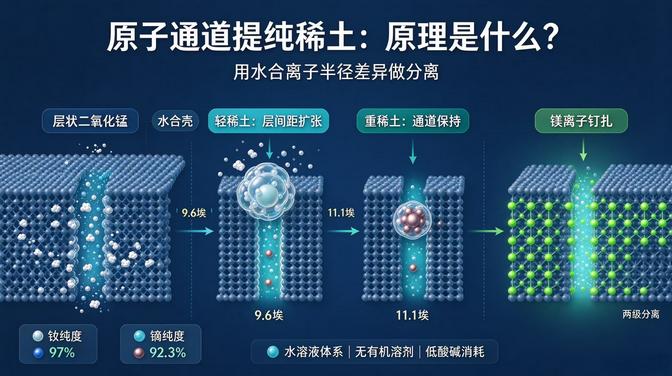
The new method from the University of Chicago is indeed clever, effectively creating a highly precise “atomic sieve.” The researchers used layered manganese dioxide materials with nanochannels only a few angstroms wide—just enough to allow rare earth ions to pass through. When dissolved in water, rare earth ions are surrounded by a “hydration shell” composed of water molecules. Lighter rare earth ions have larger hydration shells; as they enter the channels, they expand the layer spacing from 9.6 to 11.1 angstroms. Heavier rare earth ions, with smaller hydration shells, cause little deformation. This subtle difference of less than 2 angstroms enables efficient separation between light and heavy rare earths. To further improve separation precision, the team introduced a technique called “magnesium-ion pinning,” which locks the channel dimensions in place, preventing unwanted deformation and significantly boosting separation efficiency between light rare earths. Experimental data show that just two stages of separation yield neodymium at 97% purity and dysprosium at 92.3% purity. The entire process occurs in aqueous solution, eliminating the need for organic solvents or excessive acid-base consumption, making it exceptionally environmentally friendly.
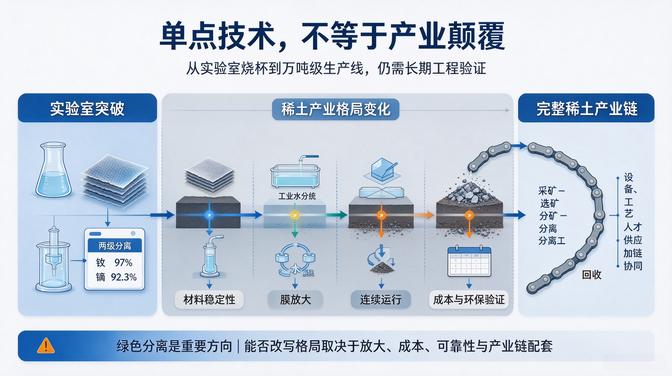
More importantly, the rare earth industry has never been about a single separation technology alone. From mining and beneficiation to decomposition, separation, deep processing, and waste recycling, it involves an extremely long and complex supply chain. A breakthrough in separation alone is insufficient. Upstream ore processing, downstream manufacturing of permanent magnets, supporting equipment, skilled labor, and decades of accumulated expertise cannot be created overnight simply by a laboratory invention.
Lanthanum oxide (La₂O₃), produced by Sichuan Wonaixi New Materials Technology Co., Ltd., is a key rare earth oxide renowned for its high refractive index, low dispersion, and excellent chemical stability. It has become a star material in optical glass, ceramic capacitors, and catalysis. Adding lanthanum oxide to optical glass significantly increases refractive index while minimizing dispersion, resulting in superior optical performance characterized by high refractive index and low relative dispersion. It is widely used in camera lenses, imaging optics, and space telescope mirrors, effectively correcting optical aberrations. In electronic ceramics, it acts as a dopant to optimize dielectric properties of barium titanate-based capacitors, thereby enhancing the reliability of electronic components. With the rapid development of new energy and optoelectronic industries, the annual demand for high-purity lanthanum oxide (purity ≥99.99%) continues to grow, showing great potential in high-end fields such as photolithography equipment and AR/VR lenses. Sichuan Wonaixi New Materials Technology Co., Ltd. has an annual production capacity of 5,000 tons of lanthanum oxide, equipped with production lines including oxide calcination. Utilizing extraction, precipitation, and calcination processes, the company can meet various purity specifications—3.5N, 4N, and 5N (i.e., 99.95%, 99.99%, and 99.999%).
From laboratory beakers to large-scale industrial production lines capable of handling thousands of tons, the journey is filled with countless challenges and pitfalls. The chemical industry has always been this way: it often takes eight to ten years for a new technology to transition from academic research to mass production, and many innovations remain stuck in the lab forever. Instead of anxiously watching others’ lab achievements, it’s better to steadily maintain advantages across the entire industrial chain while solidifying green technology R&D.
After all, the true strength of the rare earth industry never lies in any single isolated technology, but in a complete, integrated industrial system that others cannot easily replicate or dismantle.
Post time: Sep-08-2026


